
STARRY VENUS: “DO YOU FEEL IT?” – A JOURNEY FROM CINEMATIC MUSIC TO MELODIC TRANCE
STARRY VENUS: “DO YOU FEEL IT?” – A JOURNEY FROM CINEMATIC MUSIC TO MELODIC TRANCE
Starry Venus returns with a new version of “Do You Feel It?”, reimagined by electronic music legend Eric Kupper as an organic melodic trance production. In this interview, she talks about the collaboration with Kupper, the creative vision behind the new music video, and the deeper themes of connection, peace, creation, and self-expression. She also shares how Sedona, her work as a musician and visual artist, and her previous success with “Stars” continue to shape her creative journey.
INTERVIEW OF STARRY VENUS
Your Eric Kupper remix of "Do You Feel It" has gained immense attention. How did your collaboration with this electronic music legend come about?
We met through Brad LeBeau, who has been a promoter of dance music for four decades — he's legendary in and of himself. He's the one who, after hearing the music, made the connection to Eric as the perfect match. Eric is an excellent musician as well. I love working with him and his ability to bring a lot of what I feel to life. I'm a bit outside the box, and Eric knows how to work with that in a very instinctual way.
The original track won awards at European festivals such as Best Original Song and Best Dance Film. What do you think was the key moment that resonated so strongly with the jury and fans?
I have a very organic approach to how I created the music, the vocals, and the video itself. There's something very human that I think comes across in the way I recorded and put it together. I allowed room for it to create itself with the sounds and the cast, and embraced those moments of spontaneity that speak to the message. For example, the beats you're hearing in the original come from an electric handpan that’s MIDI’d in. I'm embracing that and then giving structure in and around it. It's hard to articulate — like how do you imitate a heartbeat? There's an essence in the original that was important for me to maintain artistically.
Eric Kupper reworked your song into a fully organic, melodic trance production without using AI. How do you like this new club energy compared to the original cinematic version?
I love it. When I recorded the original music in the studio, producing it and doing the original vocals, I had every intention of eventually taking it and expanding it into a dance track. I heard it all along and I wanted it to get there, so I created the original with that vision, that desire. I love melodic dance music — I have a personal and spiritual passion for connecting on the dance floor, which is why it matches so well. All the original music from my album SOUL is designed that way. I love connecting the interdisciplinary realms of various ways to create and express. There's a real beauty in dance music, and you don't need AI for any of it.
The song talks about a feminine awakening and an inner spark of connection. What emotion did you want to bring onto the dance floor through this new remix?
Ultimately it's an emotion of peace. Coming to this peaceful place of answering the question, Do you feel it? It's provocative in a way, but ultimately the answer to that is a feeling of choosing, of empowerment — it's empowering to feel peace inside the body or the spirit in a sensual moment, a desire. When you can feel peace with what you are feeling or what you are contemplating, it's like the entry point into becoming more blissful, into operating that way no matter what you feel. It's a contentment, a resolution that may not have an answer. It's a state of being. If that peace is there, you can do just about anything. That's what I'm speaking to.
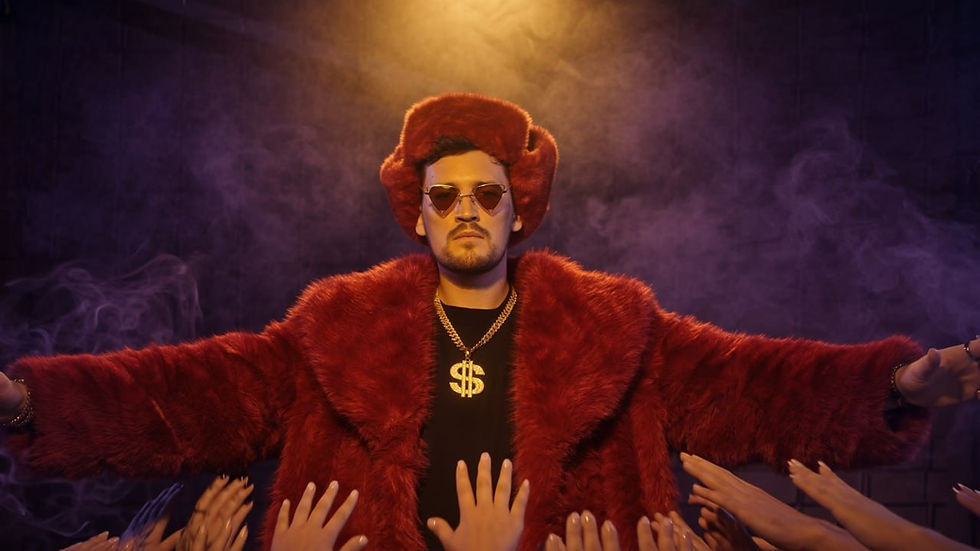
You recently produced a provocative music video for this remix, released in September 2026. Many know you write, direct, and edit your own visuals. What can we look forward to in this new video?

This video is very much a journey. I'm taking it to another level, weaving together multi-
dimensional aspects and a narrative story that expands off the original video. With this one, I decided not to hold back. It's fast-paced, like the dance song, and visually beautiful. Each character has a story that's unfolding, an identity of its own; the various narratives are speaking to each other — giving the viewer an experience as much as telling a story. I intentionally referenced many intense things that are going on in the earth right now, in nature and animals, as well as the character of Anastasia of the Ringing Cedars.
I included myself as the creator and artist who moves through these extremes that become the container from which we create. Those same extremes are playing out in the world: life and death, creation and destruction, love and loss, inspiration and the past and present. I'm weaving something that shows how all these pieces are interconnected, and it's the song that carries it. I'm presenting these extremes, but it always comes back to showing beauty, moments of connection, the way the light moves. This video is a love story to creation — very connected to the earth itself.
Your previous remix of "Stars" won Best EDM/Dance Music Video at the European Music Video Awards. When creating the new video for "Do You Feel It," do you feel the bar has been set even higher?
Yes. I feel that I set my bar higher, and yet I have to allow myself to be free and be outside of whatever that bar is, and any perceptions of that, in order to create. The recognition of the previous work has given me permission to trust my instincts.
You combine organic and electronic elements with a cinematic atmosphere in your work. How do you translate this contrast into your award-winning music videos?
I have a certain way that I approach filming and working with the cast that allows for authentic performance to come across. Even though there's a structure, there's always a free space. I create environments and film in a way to make sure the cast is able to respond and interact with me. I have key images that I know I'll get and build around that, but I also allow the environment to be a part of the creation, and I'm looking for locations that do that, or the right moment in a day. Essentially, I'm working with the environment, the light, the cast, the same way I might play a synthesizer. Within the container of key moments and scenes, we go into allowing the performer or the environment to speak, to express themselves, to connect authentically.
By being a musician and a visual artist, I’m used to trusting the moment and have a way of working with the cast and environment where we literally get into feeling it. I go on feeling just as much as I go on a specific visual. It's like playing an instrument, and I'm very hands-on as a director. In that zone of feeling, you find it because you allow it.
Your creative home in Sedona, Arizona, has a very distinct atmosphere. How do this location and your studio OMWE Productions (co-founded with Kira Mele) influence the visual side of your music?
It's phenomenal here in every way. There are things happening here with the way the light comes through and shines in the sky or on the rocks. There's an intensity to the desert itself, and also a lushness. It's metaphysically and spiritually palpable here — a rainbow can form right in front of you for no reason other than to exist. It's magical, and it's intense. I'm very inspired by that because I'm experiencing this every day and I want it to translate into the work and the video. I've lived many places, and this is where I choose to be. I'm very fed by this as an artist.
Many of the things you see in the video are real phenomena — such as a rainbow of light coming out of the sun. I get them on film and integrate them.
It's a multidimensional place, not an easy place to be, because you're constantly stimulated by so many different elements and extremes — from the desert to the creek to the light to the millions of people coming through. It's very dynamic, so I feel that it's almost a challenge: how can I integrate this and bring what I feel is so powerful here into the work in an authentic way, so that others might also connect, even if they don't know what they're seeing. Sedona is activated beyond what we would say is our normal everyday experience.
You've experienced huge success in the UK charts and won Best Alternative Album for SOUL. How do you merge the roles of singer, director, and producer into a cohesive whole without losing your vision?
I allow myself to do it because it's how I operate. I'm a big-picture person, big spirit, and I have to be patient, because while I'm doing one thing, I know it's not the only thing I'm doing — there are about ten other things I want to do in relation to that one thing, and I'm going to do them. I have to embrace that. It's exciting when I see how the elements come together, from the music to the film to the visual, or even being in a club and seeing people dance to it. That's probably the best thing, to witness that. I'm an artist, and this is the art — the weaving of these different aspects. I enjoy doing that. Ultimately it's the cinematic artist in me that wants to see all these things come together. I love all of them. There's beauty in all of it.
Comments